Back to Flick & Dave's
website
|
Sunday July 8OK OK, I'm sick of visiting amazing ruins and churches and have nothing better to do on a Sunday afternoon than sit in front of a computer screen while Flick sits on the balcony eating chocolate cake and sipping Inca Kolas (a popular local soft drink Inca gold in colour and rather like a super sweet version of Mountain Dew).
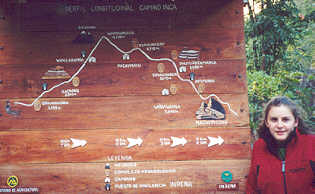
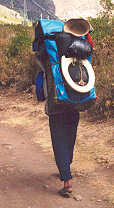
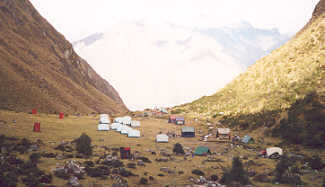
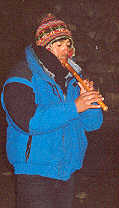
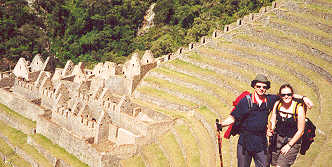
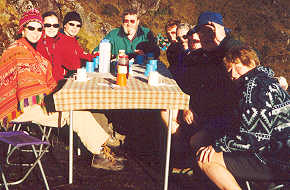
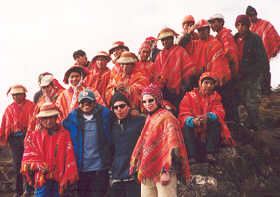
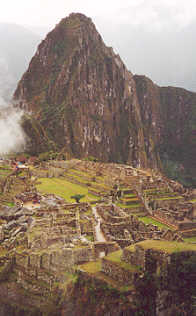
However, after following the Urubamba river valley past km 82 (the end of the road) and to km 88, the trail diverges and heads up a secondary valley system. From there (camp site 1) we climbed up to camp site 2 at 3,800m and on the third day breasted the first and highest pass (4,200m) before dropping down to 3,500m then up to camp site 3 at 3,700m. On the fourth day we topped the second pass (3,950m), descended to about 3,500 and spent the fourth night at the top of the third pass (3,600m). The last day we descended to Machu Picchu at 2,400m. Total distance about 50km, including around 2.5km of vertical ascents. It turns out that we have done the trail in about as much luxury as it is possible to do it. Our group of 10 tourists was supported by Gustavo (who played his Andean flute as we walked, the music echoing hauntingly around the mountains) and Paul (our guide assistant), head chef and two cook assistants, camp manager and a team of 24 porters, who carried all our luggage apart from our day packs. We set out before the porters each morning, but after they had finished dismantling the camp they quickly raced ahead of us. At lunch time we would come across a temporary camp site featuring a table and stools set up beneath a tent fly, complete with a hot soup, hot drinks and make your own sandwiches. At day's end we would roll into a beautiful camp site with the tents already set up and bowls of hot water waiting for us to wash in prior to afternoon tea. The toilet tent, complete with toilet seat attached to a camp stool base would also have been prepared. We were served delicious three course meals at dinner, with soup prepared from fresh vegetables, mains that included chicken breast or stuffed capsicum (a local favourite), all accompanied by a palatable Chilean wine (not Peruvian because it's not available in casks). Our tents for two were roomy four person models, and the sleeping bags were top quality Antarctic strength down models.
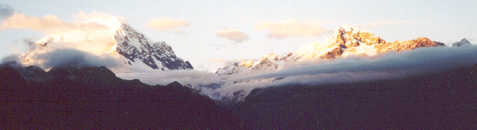
The other benefit was that our camp sites were situated at different points from the main throng, and we only encountered heavy traffic on the fourth day. This is despite a daily limit of 400 people, which, adding porters etc, means there are several thousand people along the trail at any one time during the high season. Due to the altitude we did have to take it easy, putting each foot in front of the other. We really noticed the effects on the steep sections up to the high passes. It was impossible to maintain a fast pace for long as the heart and lungs protested. But the rewards were fantastic. Breathtaking mountains and valleys, with a huge variety of flora (including heaps of orchids) and many birds. The plant life varied from alpine tundra to lush rain forest, with surprises round every corner. Although much of the trail has been rebuilt in recent times, we were able to walk over original Inca stone work, particularly on the fourth day where the trail hugged the side of the cliff with built up terraces and a couple of tunnel sections. Dawn on the fifth day brought a perfect sunrise and magnificent 360 degree views from the third pass, dominated by the 6,271m bulk of Sulcantay, the tallest peak in this section of the Andes. It has been suggested that the trail was constructed as a work of art, to inspire the pilgrims who had come to present offerings to the temples at Machu Picchu.
Another train journey awaits tomorrow to Puno on the shores of Lake Titiccaca, at 3,800m the highest navigable lake in the world.
| |||||||||||||||||||||