Back to Flick & Dave's
website
|
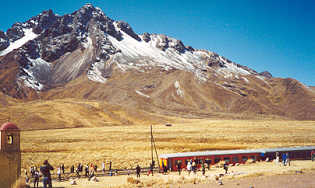
Sunday 15 JulyWell, another week of adventures have seen us move from Peru into Bolivia and on to the fabulous city of Buenos Aires in Argentina, although we seem to have arrived at a time of economic melt down. The national airline is on the verge of going bust and has been suffering from industrial problems, and we have had to make changes to several of our flights. Everything still going according to plan, though. Taking a step back, we left you in Cusco, Peru about to board the train to Puno. The journey takes us through and to the headwaters of the Urubamba River Valley (the same river that flows past the base of Machu Picchu, but this time heading South and upstream), before leaving the valley systems that eventually drain into the Amazon basin for the Altiplano. This amazing plain is all situated at 3800m and above, and drains into Lake Titicaca, which is probably one of the biggest in the Southern Hemisphere and is also noted as the highest navigable lake in the world.
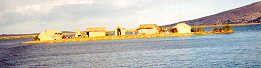
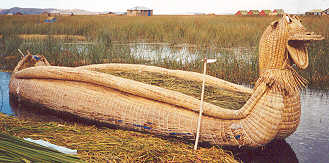
We saw heaps of alpaca and llama, the dusty and dilapidated adobe brick houses of the local farmers, and had a slow ride through the town of Juliaca, where everything imaginable (legal and illegal) is sold from stalls that encroach within inches of the train tracks. The locals there gave us dirty looks as we passed their piles of radio and motor parts, thread and textiles, food and clothing, bicycles and all sorts of other things (mostly junk). After a pleasant dinner of Lake Titicaca trout and Peruvian peasant wine (OK, the trout was nice, the wine was pretty rough) we awoke the following day in time to see the sun rise over the Lake itself. Then it was off for a full day visiting some Inca and pre-Inca ruins at Sillustani, which incidentally was on the shores of another Lake that was definitely higher than Lake Titicaca and looked fairly navigable to me, but who am I to judge? Part of the site featured towers up to 20m tall in which mummies were interred, along with (in the case of important people), various members of the family and friends of the deceased who voluntarily elected to accompany him to the next world. Apparently they also engaged in human sacrifice (always a female virgin, even better if she was a twin). They were quite nice about it though. First they got her drunk on Corn Beer, then they made sure she was stoned on cocaine and couldn't feel a thing before they smashed a stone into her skull. Nice. At lunch I made a big mistake and ordered the hamburger. Luckily the effects took a few hours to kick in and I was able to thoroughly enjoy our boat trip on Lake Titicaca out to the Uros Islands, which aren't really islands at all but boats made by heaping layer upon layer of dried totora reeds on top of each other. Weird sensation walking on them, bringing to mind the Police classic �Walking on the Moon�. There are several hundred people living on about 40 islands, and they have floating schools, floating souvenir shops, and even floating pig pens. Fascinating stuff.
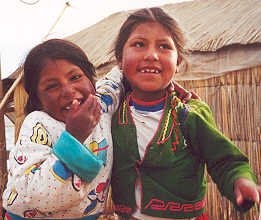
Apparently the idea originated in a means to get to the best fishing spots by staying out overnight, and then the islands became a means of escape from the oppressive Incan empire. These days their existence is looking fairly precarious in terms of what the kids want to do when they grow up: �Sure Mum, now that the government has provided me with a compulsory education telling me how great life is in the cities, I'd love to stay here on this damp mattress that needs continuous maintenance lest it sink into the Lake (which incidentally is between 2 and 12 degrees cold) and because I'm constantly drinking brackish lake water and living in a damp environment suffer from water retention and a host of other problems such as rheumatism and arthritis. No problemas.� The neat thing is that they have these nifty solar panels that provide electricity for lighting, much like the solar powered electric blanket I had most of the group believing I took with me on the Inca Trail. Well, the less said about the next 24 hours the better. Suffice to say I'm off Puno hamburgers for life. Of course, the next day we were on the move again to La Paz in Bolivia. Interesting border crossing, followed by us almost running into a blockade of striking peasants (campesinos) brandishing pitch forks. Actually, we were pretty lucky - they were letting tourists through but hadn't been a few days earlier. Police armed with an interesting assortment of weapons were also out in force, more often than not clearing the rocks piled onto the road by the campesinos in an effort to disrupt traffic.
First view of La Paz is a series of drab, ugly buildings squatting on a dusty, arid plain beneath the Royal Range. Suddenly, though, you come to the lip of a large, steep sided bowl shaped valley and the heart of the city appears magically, some 400m lower (good for the lungs, that). One of Bolivia's two capitals (figure that one out) it seems to have most of the country's wealth in hand judging by the prices we were quoted for houses in the nicer suburbs (US$500k to $2m).
Highlights included a visit to the Coca museum, all about the plant from which cocaine is derived, the leaves of which we have been drinking as a tea which supposedly helps cope with the altitude. The museum is very interesting, and what's more offers free lines on the way out!!! - just kidding. Actually its message is that while the plant has a number of legitimate uses and beneficial properties for the locals who live at altitude, its use to manufacture crack and cocaine is not something to be encouraged.
And that was pretty much the end of the organised leg of our trip. After a spectacular flight over the Andes, almost scraping the wingtip against one mountain (hope the camera was working), we're now very happily ensconced in what has turned out to be one of the most superbly located hotels in Buenos Aires, our window overlooking the Obelisco, a huge needle in the heart of the city at the centre of the world's widest street, Av 9 de Julio.
|